Meta CPA spike fix — 4-step playbook to diagnose and resolve CPA spikes
A practical, operator-level playbook for diagnosing and resolving sudden CPA spikes on Meta. Use AI to find the cause—use humans to decide. Stop pausing. Start protecting revenue.
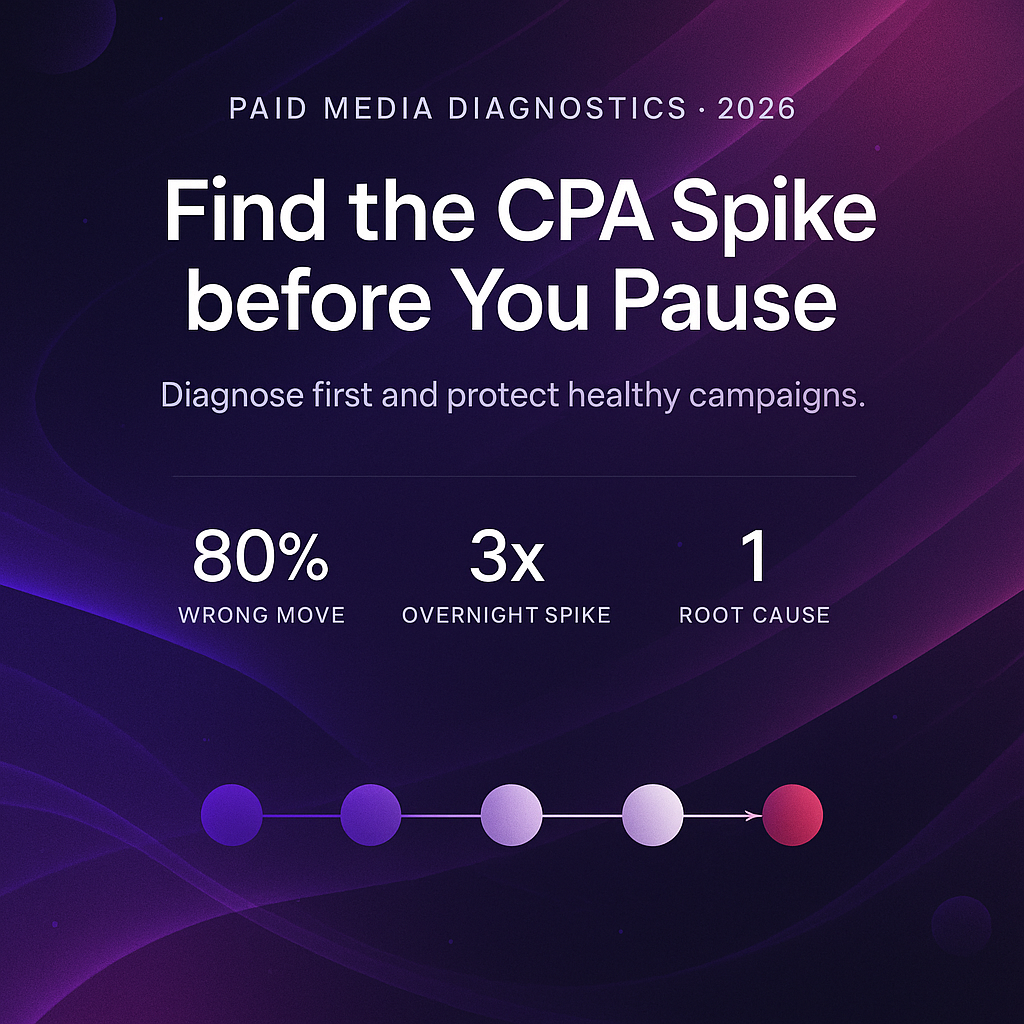
Meta CPA spike fix — CPA Spike Diagnosis & Resolution
Woke up to a 3x CPA spike at 2am. Your first instinct says "pause everything." Don't. Pause is the most expensive knee-jerk.
This is the 4-step AI playbook I run in under 8 minutes to diagnose the spike, isolate the root cause, and apply a targeted fix that protects budget and revenue. No blind stops. No theater.
Key Insights
- Decision Latency costs more than a single day's spend — it compounds.
- Most CPA spikes are solvable with targeted intervention, not blanket pauses.
- AI-as-instrument + human-as-final-decider beats either in isolation.
What's actually happening
Direct claim: A sudden CPA spike is rarely a single-failure event. It's a symptom.
Explanation: The metric change you see is the product of multiple moving parts — market noise, ad delivery shifts, creative resonance, bidding changes, landing page friction, tracking mismatches. The number explodes quickly. The mistake teams make is treating the metric as the problem rather than the signal.
What everyone gets wrong
Popular advice: pause campaigns until you understand the cause.
Why smart people believe it: pausing stops spend, and stopping spend feels safe. It prevents further visible waste while you investigate.
Why it fails: pausing kills signal. You remove the ability to test fixes quickly. You convert a recoverable incident into a multi-day customer acquisition drought. That creates aReporting Lag Tax— the unseen revenue you lose while reports are filed and tickets are opened.
The hidden cost nobody measures
Direct claim: The real damage from a CPA spike is Decision Latency, not the temporary increase in cost.
Explanation: Each hour you take to diagnose is an hour of misallocated budget, missed conversions, and eroded ROAS. The second-order effects: lowered learning signals, throttled bidding algorithms, and audience exhaustion when you restart. Teams often compound the problem by overreacting later — slashing bids, turning off high-performing audiences, or rewriting creatives without evidence.
The Anatomy of a Failure
Direct claim: Campaign failure is a chronology. Trace it.
- Trigger: A sudden metric change (CPA spikes, CPL rise).
- First-minute reaction: Slack pings, blame, frantic dashboards.
- First-hour actions: Pauses, sweeping bid cuts, creative swaps.
- Mid-term missteps: Restarting without validation, rollout of broad changes.
- Outcome: Lower conversion rates, longer recovery, lost revenue and learning.
Here’s the timeline you want instead.
- Detect with AI and flag anomaly.
- Run root-cause diagnostics automatically (8 minutes).
- Human validate the top hypothesis (5 minutes).
- Apply targeted intervention (minutes), not blanket cuts.
- Observe for a controlled window, then iterate.
8 minutes
Average time for the playbook's automated diagnostic sweep.
The 4-step AI playbook I ran in 8 minutes
Direct claim: Use AI to isolate cause; use humans to decide action.
Think about it. AI is fast at correlation and pattern-matching. Humans are fast at judgement and consequences. That's the split.
- Triage — don't pause. Isolate signal sources.What the AI checks first (automated):Why not pause: you need live signal to validate hypotheses. Pausing reduces information density and extends the Intervention Window.
- Is the spike global or localized by geo/time?
- Did any campaign-level parameters change in the last 24 hours? (bid strategy, budget, creative, audience)
- Is there a sudden drop in impressions or a shift in distribution across ad sets?
- Root-cause isolation — AI produces ranked hypotheses.AI runs three core hypotheses in parallel:The system returns a ranked list with confidence scores and the minimal data slice needed to validate each.
- External market shock — competitor activity, seasonality, traffic acquisition costs rising.
- Campaign change — recent edits to bids, budgets, target, or creative that altered delivery.
- Audience signal shift — audience saturation, pixel decay, tracking mismatch, or bad seed audience.
- Rapid validation — human confirms the AI's top hypothesis.Human steps:Decision point: If confidence >= threshold, apply targeted intervention. If not, escalate detailed diagnostics.
- Scan the AI's evidence pack (creative timestamps, impression distribution, event match rates).
- Check external signals (site analytics, server logs, partner status pages).
- Confirm there are no tracking regressions (compare pixel events to server-side events).
- Targeted intervention & monitoring — precise, reversible, observable.Interventions are surgical:Observe for one Intervention Window (commonly 1–6 hours depending on volume). If recovery, scale; if not, iterate the playbook again.
- Switch a single ad set back to previous bid strategy.
- Throttle spend only on the affected geos.
- Roll back a creative change that preceded the spike.
Three root causes AI checks (and what they mean)
- External market factors: Bid landscapes shift fast. AI checks shifts in auction dynamics and competitor impression share.
- Campaign changes: Human edits to bids, budgets, or creative change delivery algorithms. AI looks for recent change diffs.
- Audience shifts: Pixel integrity, event matching, and audience saturation. AI inspects conversion rate per cohort and tracking consistency.
| Root Cause | AI Evidence | Immediate Action | Why surgical helps |
|---|---|---|---|
| External market shock | Impression CPIs up, impression share down, competitor ad volume spike | Shift budgets to unaffected channels; tighten audience bids in hotspots | Preserves learnings and limits exposure |
| Campaign change | Recent config diffs, new creative with lower CTR, bid type change | Rollback change on suspect ad set; increase manual control on bids | Restores prior delivery behavior without halting acquisition |
| Audience shift | Conversion rate drop in core cohort; tracking mismatch | Pause new lookalikes; rehydrate pixel; enable server-side verification | Targets the cohort causing the bleed, keeps other cohorts live |
Decision tree for the first 30 minutes
Direct claim: Follow the decision tree below rather than a gut pause.
- Did AI detect a recent campaign edit? If yes → validate and rollback candidate edits.
- No campaign edits → did AI detect tracking anomalies? If yes → quick pixel/server check and fix.
- No tracking anomalies → is the spike localized? If yes → throttle affected geos/ad sets.
- None of the above → escalate to deeper diagnostics; preserve most of the traffic while you work.
Quick checklist: What AI should show in the evidence pack
- Timestamps of last edits for every campaign and ad set.
- Impression, CTR, CPC, CPA deltas by ad set and creative.
- Event match rate — pixel vs server events.
- Top 3 correlated signals (time, geo, creative) with confidence scores.
The Unit Economics: The true math of delay
Direct claim: You can model the cost of Decision Latency precisely — no narratives required.
Explanation: Define variables. Don’t invent numbers — use your account's baseline values.
- Baseline CPA = B
- Spiked CPA = S
- Daily budget = D
- Decision latency (hours) = L
Revenue leak over L hours approximates: (S - B) * (D / B) * (L / 24)
Why this matters: The longer you wait, the more you pay above baseline. But the hidden multiplier is lost learning. Each day of poor data shifts your optimization algorithms and increases future CPAs. That’s thePerformance Decay Curve.
The Technical Bottleneck
Direct claim: Most teams fail because of broken plumbing, not incompetent ads.
Explanation: The API and pipeline layer creates false alarms and hides real signals. Ads Manager shows aggregated numbers; your control plane needs event-level telemetry.
Deep-dive: Where the pipeline breaks
- Tracking drift — pixel misfires or duplicate firing.
- Attribution window mismatch across platforms.
- Ad platform reporting delays or sampling artifacts.
- Downstream ETL jobs that overwrite event timestamps.
Remediations that actually work
- Implement server-side event forwarding and compare to client-side events.
- Snapshot campaign config diffs; never rely on human memory.
- Instrument an anomaly gate that surfaces the minimal failing slice, not full account noise.
The Intervention Protocol — minute-by-minute
Direct claim: Replace panic with a protocol. Execute with discipline.
- 0–5 minutes: AI triage runs; keep campaigns live. Assign owner.
- 5–15 minutes: Review AI ranked hypotheses. Human validates top item.
- 15–30 minutes: Apply a surgical fix (rollback, throttle, re-route). Keep other traffic untouched.
- 30–90 minutes: Monitor recovery in the Intervention Window. Capture telemetry snapshots every 10 minutes.
- 90+ minutes: If no recovery, run second pass of diagnostics and widen the data slice carefully.
What's different here: speed and containment. You accept near-term cost of diagnostic traffic to avoid long-term revenue bleed. That's the essence ofDecision Latencyreduction.
Comparison: AI ad monitoring vs manual Ads Manager
| Capability | AI-assisted Diagnostics | Manual Ads Manager |
|---|---|---|
| Speed | Minutes to surface candidate root causes | Hours to assemble evidence |
| Actionability | Provides targeted, reversible interventions | Leads to broad, error-prone changes |
| False positives | Lower with correlation-based filters | High, due to noise and lack of slicing |
| Human oversight | Built into decision loop | Often absent until after damage |
Operational playbook: exact commands for engineers and media buyers
Engineers, run these in sequence. Media buyers, watch and confirm.
- Snapshot campaign config: export campaign, ad set, creative hashes and timestamps.
- Run event reconciliation: compare client and server event counts for last 24 hours per geo.
- Check for recent edits via API: query campaign change logs for
modified_time. - If creative CTR dropped more than expected in affected ad sets, mark creative as suspect and isolate it.
- If attribution mismatch found, enable server-side validation and pause new lookalikes only.
- Document each step in a shared incident log with timestamps.
Sample API checks
- GET /campaigns?fields=effective_status,insights&since=24h
- GET /ads?fields=creative,insights{impressions,ctr,cpc,actions}
- Log diff: compare current config to 24h snapshot via hash comparison.
Human + AI governance: how to avoid strategic suicide
Direct claim: Relying on AI alone to diagnose a CPA spike is a recipe for strategic suicide.
Explanation: AI is fast at narrowing hypotheses. But without human context — product launches, PR events, competitor promotions — the AI's top recommendation can be wrong. Always require a human authorization step for irreversible actions.
Rule: Automation suggests. Humans authorize. Systems enforce.
Feature name
We call the capabilityCPA Spike Detection. It’s an AI-driven diagnostic layer that returns ranked root causes, confidence, and the minimal slice required for validation. It recommends surgical actions — not sweeping pauses — and includes an embedded human-authorization gate.
Expert opinion
AI should be your detective, not your dictator. The goal is faster intervention, not automated martyrdom.
Case logic examples (no client names)
Example A: A campaign shows a CPA spike. AI finds a recent creative swap 3 hours prior with a simultaneous drop in CTR on a high-volume ad set. Action: rollback the creative on that ad set and monitor. Result: conversion rate returns toward baseline within the Intervention Window.
Example B: A spike occurs across multiple campaigns in a single geo. AI flags a surge in competitor impression share and rising CPCs. Action: reduce spend in that geo and reallocate budget to unaffected regions while investigating pricing dynamics. Result: spend preserved elsewhere and time bought to adjust strategy.
Implementation checklist for teams
- Instrument an anomaly detector that ranks hypotheses and slices minimal evidence.
- Define Intervention Windows for each campaign tier.
- Create a human-authorization workflow for irreversible actions.
- Snapshot configs hourly during high-risk periods (launches, sales).
- Train one incident owner per shift to avoid multi-leader chaos.
Why this matters now
Direct claim: If you wait until the report arrives, it’s already too late.
Explanation: Reports explain yesterday. Your job is to protect tomorrow. Cutting budgets or pausing everything is theater. What saves revenue is targeted intervention inside the Intervention Window.
Strategic insight
Most teams don't have a visibility problem. They have a response-time problem. Speed, containment, and human judgment inside a closed-loop system are what stop budget drain.
Call to action
If you want to see this in action, request a demo of the CPA Spike Detection feature. Watch a live diagnostic run, see the ranked hypotheses, and experience a surgical rollback in a test account. It’s the fastest way to reduce Decision Latency and protect ROAS.
Closing
Don't let a number dictate strategy. Numbers report. Humans decide. AI points. That’s the only way to prevent compounding revenue leakage.
FAQ
How does the Meta CPA spike fix process start without pausing campaigns?
Start with automated triage. The system runs fast diagnostics across geometry, recent edits, and tracking integrity while campaigns remain live. Pausing removes the live signal you need to validate hypotheses. The goal is to preserve information while containing exposure through targeted throttles.
Can AI reliably tell whether a CPA spike is due to tracking or real conversion loss?
Yes, AI can surface high-confidence indicators by comparing client-side and server-side event streams, checking event timestamps, and correlating conversion drops with config diffs. It returns a ranked hypothesis and the minimal dataset needed for human validation, but human context is required before irreversible actions.
What immediate actions should agencies take when they detect a sudden cost per acquisition spike?
Run an AI diagnostic sweep, validate the top hypothesis, and apply a surgical fix only to the affected slice (rollback, throttle geo, isolate creative). Document each change and monitor within a pre-defined Intervention Window. Avoid blanket pauses unless tracking proves irrecoverably broken.
How does CPA Spike Detection compare to manual Ads Manager troubleshooting?
AI diagnostics surface root-cause suggestions in minutes and provide evidence slices. Manual troubleshooting is slower and often leads to broad changes. Combined, AI plus human authorization reduces Decision Latency and prevents misdirected interventions that cost revenue.
What prevents false positives from the automated system?
The system uses correlation filters, config diff checks, and event reconciliation to reduce noise. Every suggestion is paired with confidence scores and the minimal data slice for validation. Humans authorize any irreversible action, ensuring context-sensitive judgment.