Meta CPA Spike Fix: Diagnose the Root Cause Before You Pause
Your CPA tripled overnight. The wrong move is to panic-pause. Use AI to isolate the root cause across auction, conversion path, and tracking before you touch spend.
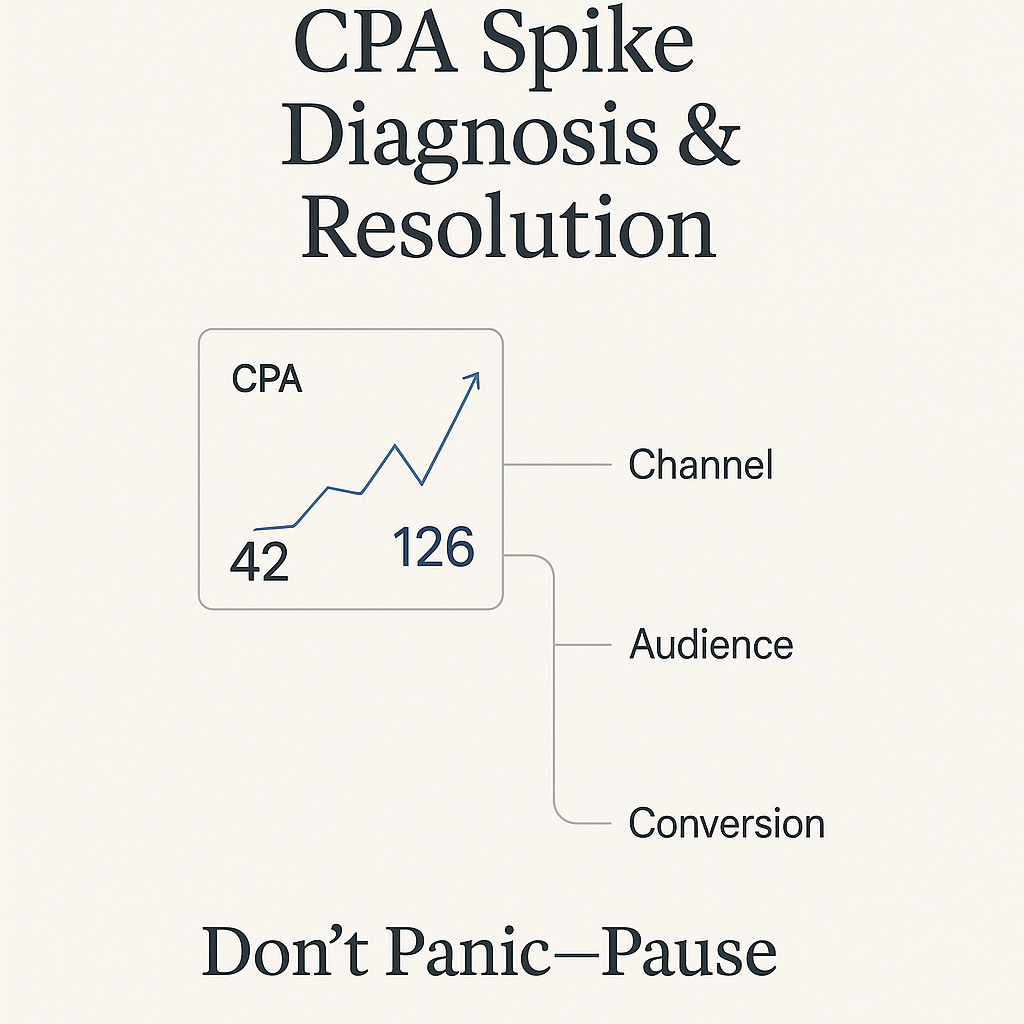
CPA Spike Diagnosis & Resolution: The Meta CPA Spike Fix That Keeps Healthy Campaigns Alive
Woke up to a 3x CPA spike at 2am. The instinct is familiar: kill spend, pause the ad set, blame the campaign, and clean up the mess in the morning. That move feels responsible. It also destroys good campaigns for the wrong reason.
Here’s the problem. A sudden cost per acquisition spike is usually not a single failure. It’s a chain of failures that your team only notices at the end of the chain. By the time the dashboard screams, the damage has already moved through auction pressure, delivery changes, lead quality, or landing page friction. That’s why the real fix is not panic control. It’s faster diagnosis.
Most teams treat a Meta CPA spike fix as a budget decision. It isn’t. It’s a response-time problem. The goal is not to react first. The goal is to identify the actual fault line before you make a bad change to a healthy system.
Expert opinion: If your first move after a CPA spike is to pause everything, you are not managing campaigns. You are managing fear.
What Actually Breaks During a Sudden CPA Spike
Direct claim: A sudden cost per acquisition spike usually comes from one of three systems breaking: the auction, the lead path, or the tracking layer.
That’s the useful frame. Not “the campaign is bad.” Not “Meta broke.” Not “the audience is tired.” Those are lazy labels. What’s actually happening is more specific: either the cost to win the impression changed, the ability to convert traffic changed, or your measurement changed.
This is why historical habits fail. Teams look at last week’s CPA and compare it to today’s CPA like the market is static. It isn’t. Creative competition changes. Conversion intent changes. Landing page behavior changes. Lead quality shifts. And when those shifts hit overnight, the old benchmark becomes a crutch.
The hidden issue is decision latency. The longer it takes your team to identify the root cause, the more expensive the mistake becomes. You either keep wasting spend on a broken path or you cut a healthy one.
3
Three places to look first in a Meta ads root cause analysis: auction cost, conversion path, and tracking integrity.
The 4-Step Meta CPA Spike Fix AI Should Run First
Direct claim: A proper Meta CPA spike fix starts with diagnosis, not intervention.
AI is useful here because it can check the obvious suspects faster than a human can click around Ads Manager for twenty minutes and still guess. That matters. Most teams do not lose money because they lack data. They lose money because the diagnosis arrives too late.
Here’s the step-by-step playbook.
- Check for a delivery shift. Did impressions, CPM, CTR, or frequency move sharply? If CPM jumped first, the problem may be auction-side. If CTR collapsed first, the problem may be creative or offer-side.
- Check for a conversion path break. Did click-through remain stable while ATC, IC, or lead completion dropped? If yes, the issue is downstream from the ad itself.
- Check for tracking distortion. Did conversions fall while landing page traffic and on-site engagement stayed normal? That can point to a pixel, CAPI, attribution, or event loss problem.
- Check for lead quality inversion. Did CPA rise because lead cost spiked, or because cheaper leads stopped converting? That difference matters. One is acquisition cost. The other is intake quality.
That sequence is the difference between intervention and theater. You do not need more dashboards. You need a decision tree that tells you where the failure started.
Quotable axiom: The first number that moved is usually not the number that failed.
What Everyone Gets Wrong About a Sudden Cost Per Acquisition Spike
Direct claim: Most teams assume the campaign is broken before they know which layer broke.
That sounds efficient. It usually isn’t. Smart people believe it because they have seen enough ugly spikes to know that spend can burn fast. So they reach for the fastest containment move: pause, cut, or rebuild. The irony is that this reaction often amplifies the damage.
Why? Because a healthy campaign can look guilty when the real issue sits elsewhere. A landing page deploy, a CRM sync failure, a broken event, or a lead qualification shift can all create the same surface symptom: ads not converting. If you respond at the symptom layer, you protect nothing.
Here’s the hidden cost nobody measures: you don’t just lose the current hour of spend. You also erase the signal you needed to understand whether the system was recovering on its own. That creates a second-order effect. Your team starts making decisions from incomplete data, and the next incident gets diagnosed even worse.
Most teams miss this: a quick pause can make later analysis impossible. Once delivery history is disrupted, you lose the clean comparison you needed to see whether the spike was temporary, structural, or isolated.
1
One wrong pause can create more uncertainty than the spike itself by destroying the comparison window you needed for diagnosis.
The Anatomy of a Failure: How CPA Tripled Overnight
Direct claim: A CPA tripling overnight is rarely a single event. It is usually a sequence.
Think about it in chronological order.
- Something changes upstream. Maybe competition rises. Maybe the audience pool gets narrower. Maybe the creative starts attracting lower-intent clicks.
- The system absorbs the change. Early on, the campaign still delivers. This is why teams miss the signal. They expect instant collapse, but performance often decays in stages.
- Conversions begin to weaken. The first visible symptom may be a falling CVR, a rising CPL, or a reduced lead-to-opportunity rate.
- Reporting catches up late. By the time the dashboard shows a full CPA spike, multiple upstream decisions have already compounded.
- Humans overreact. Now the team cuts budget, edits the ad set, changes audiences, swaps creative, and blurs the evidence.
This is the failure pattern behind most Facebook ads CPA increase incidents. The campaign did not “suddenly become bad.” The performance decay curve was already in motion.
That’s where things break: people treat the final number as the cause. It’s not. It’s the receipt.
Technical deep dive: why the diagnosis needs AI
Manual troubleshooting in Ads Manager is slow because it forces humans to check one layer at a time. The problem is not that people are incompetent. The problem is that campaign systems move faster than human memory and slower than human intuition, which creates blind spots.
An AI campaign diagnostics layer can compare metric movement across the funnel at once. That means it can detect whether the issue is likely in acquisition, conversion, or attribution without waiting for a weekly report or a full analyst review. In a true anomaly, speed matters more than perfect certainty.
The Unit Economics of a CPA Spike
Direct claim: A CPA spike is a budget leak, but the real damage is in margin compression.
If CPA triples, the first response is often “we’re spending too much.” That’s only part of the story. The real question is what the higher acquisition cost does to your unit economics.
Let’s keep it simple.
- If your allowable CPA was $50 and it jumps to $150, every conversion now costs $100 more than planned.
- If you buy 40 conversions during the spike, that is $4,000 in excess spend relative to plan.
- If those conversions were also lower quality, the true loss is larger because downstream close rate and revenue per lead may also fall.
This is why a sudden lead cost spike is not merely a media issue. It’s a revenue planning issue. The campaign might still be generating volume, but the economics no longer support it.
Protect ROAS is not a slogan here. It is the operational objective. If you can isolate the root cause fast, you can preserve profitable spend while stopping the part of the system that is actually leaking margin.
$4,000
At a $100 overage per conversion, just 40 conversions during a spike can create $4,000 in excess spend before you even count downstream quality loss.
The Technical Bottleneck Nobody Wants to Admit
Direct claim: In many cases, the failure is not Meta delivery. It is the workflow around Meta.
That means the real bottleneck may be API lag, event loss, CRM delay, or human review time. The ad platform gets blamed because it is the visible surface. But often the system underneath is what failed.
Common technical breakpoints include:
- Pixel or CAPI mismatch causing missing conversion events.
- Landing page latency reducing completion rate after the click.
- Lead routing failures causing qualified leads to sit uncontacted too long.
- Attribution delay making healthy conversions appear absent.
- Data sync issues between Meta, analytics, and CRM systems.
Most teams only inspect the ad account. That’s backwards. The signal might have died before it ever reached the reporting layer.
Decision latency gets worse here because each department waits for another one to verify the issue. Media blames web. Web blames CRM. CRM blames reporting. Meanwhile budget drains.
How automated root cause analysis shortens the chain
Automated root cause analysis is valuable because it can compare event timing, conversion movement, and delivery changes in one pass. Instead of waiting for each team to manually inspect its own slice, the system flags the most probable failure zone first. That is not magic. It is operational triage.
This is exactly where an AI ad monitoring tool earns its keep: not by generating more alerts, but by narrowing the search before money bleeds further.
The Decision Tree: What to Do Next Without Panicking
Direct claim: The right response to a CPA spike is a narrow set of moves based on what moved first.
Use this decision tree.
| What moved first | Likely issue | What to inspect | Action |
|---|---|---|---|
| CPM up, CTR stable | Auction pressure | Audience saturation, competition, placement mix | Adjust bidding, refine audience, test new creative |
| CTR down, CPM stable | Creative or message mismatch | Hook, offer, format, thumb-stop rate | Replace weak creative before changing structure |
| Clicks stable, conversions down | Landing page or funnel break | Form completion, page speed, checkout flow | Fix the conversion path, not the media |
| Conversions disappear without site issues | Tracking distortion | Pixel, CAPI, attribution, event firing | Verify measurement before changing spend |
| Lead volume stable, sales quality down | Lead qualification shift | Lead source mix, routing, sales follow-up timing | Protect pipeline quality, not just CPL |
That table is the difference between a Meta ads troubleshooting session and a guessing contest. The point is not to freeze. The point is to move precisely.
Think about it: if you know the first variable that broke, you know what not to touch.
Why Historical Data Can Make the Spike Worse
Direct claim: Historical data is useful only when the system is stable. In a spike, it can mislead you.
There is a reason teams cling to historical data. It feels safe. It gives context. It helps establish normal ranges. But when market behavior changes quickly, the past can become a comfort blanket that slows action.
That does not mean ignore history. It means stop treating it like prophecy. A campaign with yesterday’s efficiency is not guaranteed today’s efficiency. Consumer behavior, auction density, and conversion friction move independently.
This is why the old habit of comparing every anomaly to a weekly average creates blind spots. The average hides the inflection point. AI is useful because it can compare micro-shifts across the funnel, not just broad trend lines.
The hidden cost: historical dependence creates a reactive analytics trap. Teams spend too long proving the spike exists instead of proving where it started.
Rule of intervention: When the system changes faster than your weekly report, history becomes lag, not insight.
How the CPA Spike Detection Feature Changes the Job
Direct claim: The point of a CPA Spike Detection feature is not more alerts. It is faster intervention.
That distinction matters. Alerts without diagnosis just create noise. What teams need is a signal that says: this spike is likely coming from auction pressure, conversion breakage, or tracking distortion. Then the next move becomes obvious.
That is what a good AI ad monitoring software should do. It should reduce the time between anomaly and action. Not by replacing judgment, but by removing the first ten minutes of guessing.
Here’s the practical payoff:
- Less spend wasted while teams debate the cause.
- Fewer healthy campaigns paused out of fear.
- Faster fixes to the actual broken layer.
- Cleaner learning from each incident.
That is campaign intelligence. Not reporting. Not dashboards. Intervention.
8
Minutes can matter more than days when the goal is to stop budget drain before the spike compounds.
The Intervention Protocol for a Sudden Meta CPA Spike
Direct claim: When CPA spikes overnight, teams need a protocol, not a debate.
Use this sequence.
- Freeze the temptation, not the campaign. Do not make a blanket pause decision in the first minute.
- Run the 4-step diagnostic. Delivery, conversion path, tracking, lead quality.
- Identify the first broken layer. Do not fix downstream symptoms before confirming the source.
- Make the smallest effective change. Swap the creative, repair the page, verify the event, or adjust the audience only where the data points.
- Watch the next movement. Confirm whether CPA stabilizes, because the next signal tells you if the fix was real.
This is where teams either protect ROAS or deepen the loss. Fast but narrow action beats broad panic every time.
Most teams miss this: the best intervention is often the smallest one. Not because you’re being conservative. Because precision beats drama.
AI Ad Monitoring vs Manual Ads Manager Troubleshooting
Direct claim: Manual troubleshooting is slower, narrower, and easier to distort under pressure.
Ads Manager is useful. It is not enough. A human scrolling through charts under stress will overfocus on the most obvious number and underweight the supporting signals. That’s how healthy ad sets get killed.
| Approach | Strength | Weakness | Best use |
|---|---|---|---|
| Manual Ads Manager troubleshooting | Human judgment and context | Slow diagnosis, bias under pressure | Final verification and creative decision-making |
| AI ad monitoring tool | Fast anomaly detection and pattern comparison | Needs clear rules and good data | Early root cause identification and alerting |
The comparison is not AI versus people. It is AI versus delay. The commercial difference is simple: the faster you know what broke, the less budget waste you absorb.
What Leaders Should Change Right Now
Direct claim: The real fix is a governance change, not just a tooling change.
Most organizations already have enough data. They do not have a fast enough response model. That’s why campaign diagnostics should be built around intervention thresholds, not vanity reporting.
Leaders should define three things before the next spike hits:
- Who owns the first diagnosis?
- Which metrics decide the branch in the decision tree?
- What action is allowed before the full postmortem?
Without those rules, every spike becomes an argument. With them, it becomes a controlled workflow.
The best operators know this instinctively. They are not trying to monitor more. They are trying to intervene sooner.
FAQs About Meta CPA Spike Fix and Campaign Diagnostics
What is the first thing to check when CPA triples overnight?
Check which layer moved first: delivery, conversion, or tracking. A Meta CPA spike fix starts by identifying whether CPM, CTR, site conversion, or event capture changed before the final CPA number did. That tells you where the failure began and prevents you from pausing or editing the wrong part of the campaign.
Should I pause campaigns immediately after a sudden cost per acquisition spike?
No. Pausing should not be the first move. A sudden cost per acquisition spike often comes from a specific break in the auction, landing page, or measurement layer. If you pause too fast, you may hide the signal and make diagnosis harder. First isolate the cause, then decide whether the campaign actually needs to stop.
How does AI help with Meta ads troubleshooting?
AI helps by narrowing the likely root cause faster than manual review. In Meta ads troubleshooting, that means comparing funnel movement across metrics so you can see whether the issue is creative, conversion path, tracking, or lead quality. The value is speed to intervention, not more reporting.
What causes Facebook ads CPA increase besides creative fatigue?
Creative fatigue is only one possibility, and it is not always the real one. A Facebook ads CPA increase can also come from auction pressure, landing page friction, pixel or CAPI loss, attribution delay, or lower lead quality. The right response is to diagnose the first broken layer, not default to a creative-only explanation.
How do I stop budget drain during a sudden lead cost spike?
Stop the budget drain by identifying whether the spike is an acquisition issue or a quality issue. A lead cost spike may reflect higher media costs, but it may also mean leads are converting worse downstream. Use a structured diagnostic flow so you fix the actual source instead of cutting a campaign that still has value.
What does CPA Spike Detection do differently from normal monitoring?
CPA Spike Detection is built for intervention, not hindsight. Normal monitoring tells you that performance changed. Spike detection should tell you where the change likely started so the team can act immediately. That is the difference between reporting yesterday’s damage and preventing tomorrow’s waste.
How do I know if the issue is the ads or the landing page?
Look at the funnel sequence. If clicks hold steady but conversions fall, the landing page or funnel is the likely problem. If CTR drops first, the ad side is more likely at fault. This is why campaign diagnostics matter: they help you separate media problems from post-click problems before you make unnecessary changes.
The teams that win are not the ones with the most dashboards. They are the ones that can tell, in minutes, whether to act, wait, or leave a healthy campaign alone.
That is the difference between campaign management and campaign intelligence.