Real-Time Ad Spend Leakage Prevention | Stop Meta Ad Budget Leak Fast
A Meta ad budget leak does not wait for your weekly report. Real-time ad spend anomaly detection catches placement bleed, audience exclusion failure, and rogue ad sets before wasted spend compounds into lead quality damage and slower recovery.
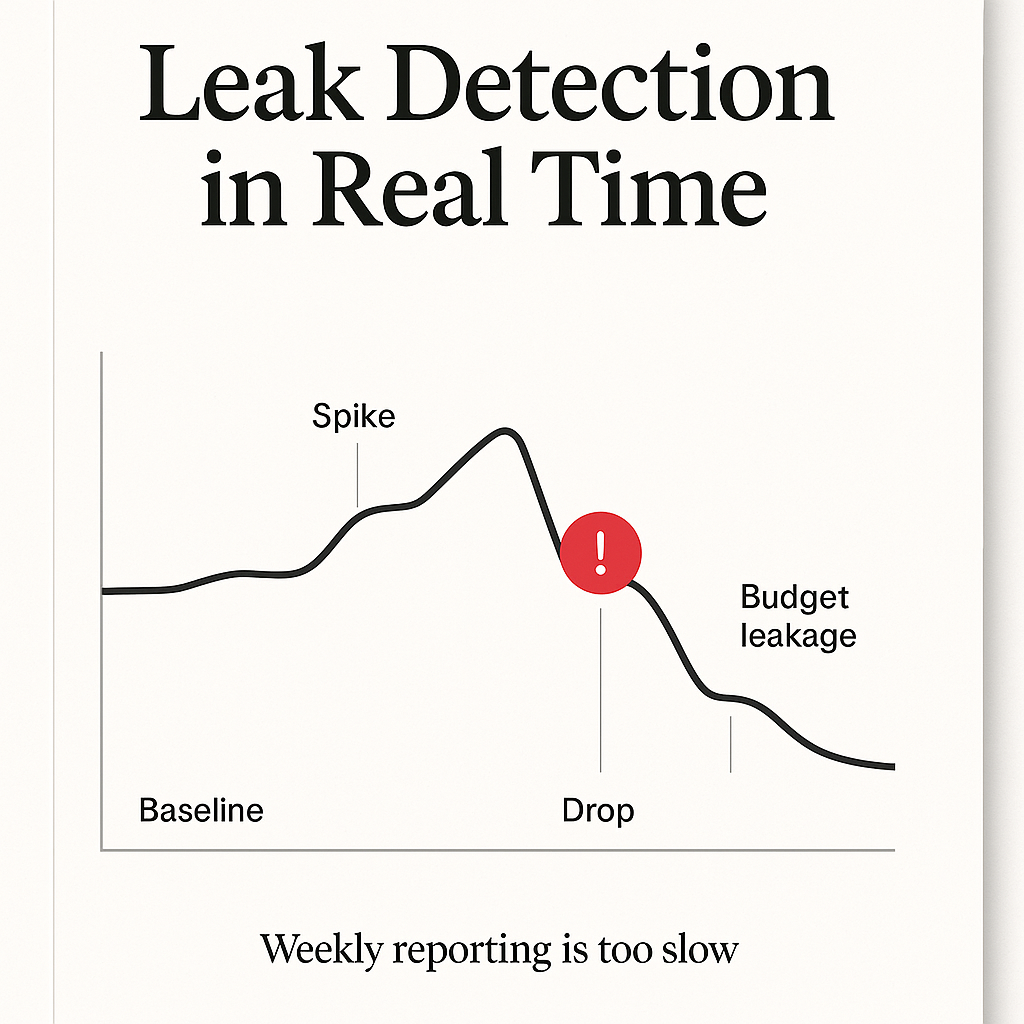
Real-Time Ad Spend Leakage Prevention: Why Weekly Reports Arrive After the Money Is Gone
₹40,000 drained overnight into a placement we'd excluded. The report didn’t catch it until the next day. By then, the Meta ad budget leak had already done the damage.
That is the part most teams still refuse to admit: the campaign did not fail when the report showed it. It failed in the hours before anyone looked.
If you are relying on weekly reporting, you are not managing spend. You are performing autopsy work after the budget leak has already turned into Facebook ads wasting money, distorted learning, and delayed recovery.
Core claim: Real-time ad spend anomaly detection is not a nice-to-have. It is the only practical way to stop ad budget drain before it compounds into wasted spend, bad optimization, and lost revenue.
What Actually Happened
Here’s the problem. A Meta ad budget leak rarely looks dramatic in the moment. It starts as a placement bleed, a broken exclusion, a rogue ad set spending money, or a sudden shift in delivery that nobody notices until the report lands.
That delay matters. The spending did not wait for your team to be ready. The platform kept bidding, the budget kept burning, and the only thing that changed was the timestamp on the spreadsheet that finally told you what was already gone.
The real failure is not the bad spend. The real failure is the response time.
What Everyone Gets Wrong About Meta Ad Budget Leak
Most operators still believe the weekly report is the control system. It is not. It is a record of what the control system failed to stop.
Smart people believe in reports because reports feel disciplined. They create order. They make teams look rigorous. They support review meetings, approvals, and neat postmortems.
That is backwards. A weekly report can tell you where the money went. It cannot stop the money from leaving.
The industry keeps treating this as a visibility issue. It is not. It is adecision latencyproblem.
Law: When spend moves faster than review, the budget belongs to the platform, not the team.
Why Real-Time Ad Spend Anomaly Detection Is the Only Lifeline
Direct answer: real-time ad spend anomaly detection catches leaks while they are still small enough to fix.
That is the entire business case. Not dashboards. Not prettier reporting. Not another summary in Slack after the damage is done. Real-time ad monitoring reduces the gap between signal and intervention.
Think about it. If a placement starts consuming budget after it should have been excluded, the team needs to know immediately. If a campaign suddenly accelerates spend without matching lead quality, the team needs to know immediately. If an audience exclusion failure causes junk lead spend, the team needs to know immediately.
That is what ad spend anomaly detection is for. It protects the intervention window.
The Intervention Window
The short period in which a campaign leak is still recoverable without dragging the whole account into waste, noise, and false learning.
The Three Anomaly Types AI Flags Before Damage Spreads
Direct answer: the most useful anomaly detection ads systems flag placement bleed, audience exclusion failure, and rogue spend patterns.
Those are the leaks that quietly drain accounts.
- Placement bleed detection. Spend flows into placements that should have been controlled, limited, or excluded. The platform may still consider this “efficient delivery.” Your bank account will not.
- Audience exclusion failure. The system keeps paying for people it should have removed from delivery. That creates wasted ad spend, polluted learning, and prevent junk lead spend at the same time.
- Rogue ad set spending money. One ad set starts consuming far more than the rest, often because bidding, creative rotation, or delivery conditions changed faster than the team noticed.
These failures are not rare. They are simply too fast for manual monitoring to catch consistently.
And that is the trap. The worse the leak, the more confident the weekly report can make a team feel because the damage is already hidden inside aggregated averages.
The Anatomy of a Failure
Direct answer: a campaign disaster usually unfolds in five predictable steps, and each step gets more expensive because nobody intervenes fast enough.
This is the pattern I keep seeing.
- Something changes in delivery. A placement slips through, an exclusion breaks, an ad set starts taking more budget, or a creative begins pulling bad traffic.
- Nothing reacts. The team assumes the daily check will catch it. Or the weekly report will surface it. Either way, the spend continues.
- The account learns the wrong lesson. The platform optimizes toward the bad pattern because it has more data on the wrong behavior than the team has time to correct.
- Lead quality drops. Now the leak is not just budget. It is also pipeline contamination, sales frustration, and a false sense of demand.
- The recovery is slower than the damage. Even after the fix, the account carries the scar tissue of the bad period.
That is why weekly reports vs real-time alerts is not a formatting debate. It is a survival question.
The Hidden Cost Nobody Measures
Direct answer: the hidden cost is not just wasted ad spend. It is the compounding effect of delayed correction.
When money leaks overnight, the first loss is obvious. The second loss is less visible. The team wastes time investigating after the fact, the account trains on bad data, and leadership makes decisions using broken numbers.
Then the third loss hits. People start trusting the channel less. They slow approvals. They add more reviews. They try to compensate with process because the system cannot intervene fast enough.
That is the real tax: theReporting Lag Tax. It is what you pay when signal arrives after the decision should have been made.
Rule: Every hour you wait to correct a spend anomaly increases the odds that the platform will normalize the wrong behavior.
Unit Economics of a Meta Ad Budget Leak
Direct answer: the cost of a leak is larger than the leaked spend because it distorts downstream economics.
Let’s keep this simple. The money lost to a bad placement is only the first layer. The second layer is the wasted clicks. The third layer is the lead quality damage. The fourth layer is the opportunity cost of not reallocating that budget earlier.
When a team ignores a Meta ad budget leak, the math stacks up in the wrong direction:
| Cost Layer | What It Looks Like | Why It Hurts More Than It Seems |
|---|---|---|
| Direct spend loss | Budget disappears into the wrong placement or ad set | The obvious loss is only the first bill |
| Wasted click layer | Clicks arrive, but they are low-intent or irrelevant | You pay for traffic that never had a real chance to convert |
| Lead contamination layer | Bad leads enter sales follow-up | Sales time gets burned on people who should never have been in the funnel |
| Learning distortion layer | The platform optimizes toward the wrong signals | The next spend is shaped by the wrong history |
| Opportunity cost layer | Better campaigns never get the capital | Winning gets delayed because losing kept funding itself |
This is why “we only lost a few thousand” is a dangerous sentence. A few thousand in avoidable spend can become a much larger hidden drag once you include the damage to conversion quality and timing.
Why Daily Checks Still Fail
Direct answer: daily checks are better than weekly reports, but they still miss the real problem when leaks happen between reviews.
Here’s the problem. Manual monitoring has a human ceiling. A person can only inspect so many accounts, placements, ad sets, and signals before something slips through. That ceiling gets lower as account complexity rises.
Daily checks also create false confidence. Teams feel covered because they are “looking every day.” But if the spend anomaly begins at 1:12 a.m. and the check happens at 10:30 a.m., the damage is already in motion.
That is why manual monitoring vs AI anomaly detection is not a close call. One is scheduled observation. The other is active intervention.
1 Day
A full day of delay is enough for a small leak to become a meaningful budget problem.
And this matters because ad systems do not wait for your dashboard rhythm. They keep moving. Your process should too.
The Technical Bottleneck
Direct answer: the bottleneck is rarely the ad platform itself. It is the delay between platform data, human review, and a decisive alert.
Most teams pull data, inspect it later, and then discuss it in a meeting. That workflow is built for analysis, not prevention.
What breaks is the pipeline from signal to action:
- platform events arrive in fragments,
- reports aggregate too slowly,
- humans review too late,
- and the budget keeps moving while nobody is authorized to stop it.
The fix is not just “more data.” It is real-time ad monitoring connected to a response path. If an anomaly is detected, the right person gets the alert, sees the affected account or ad set, and has a clear next move.
How the alert pipeline should work
Data comes in continuously. The system compares live spend behavior against expected patterns. When the deviation crosses a threshold, it triggers an immediate alert for placement bleed detection, audience exclusion failure, or rogue ad set spending money. The alert is specific, not vague. It should tell the operator what changed, where it changed, and what to inspect first.
Real-Time Alerts vs Weekly Reports
Direct answer: weekly reports explain loss. Real-time alerts prevent it.
The difference sounds small until you run the account under pressure. Then it becomes obvious.
| Dimension | Weekly Reports | Real-Time Alerts |
|---|---|---|
| Purpose | Review what happened | Interrupt what is happening |
| Speed | Slow | Immediate |
| Impact | Post-mortem | Prevention |
| Failure mode | Damage already done | Leak caught while recoverable |
| Team behavior | Explains yesterday | Protects tomorrow |
That is why the best teams stop asking, “What happened last week?” They ask, “What needs intervention right now?”
The Intervention Protocol
Direct answer: teams need a simple escalation path that turns anomaly detection into action within minutes.
Without a protocol, alerts become noise. With one, alerts become leverage.
- Define the anomaly thresholds. Decide what counts as abnormal spend movement, placement drift, or exclusion failure.
- Route alerts to a human owner. No ambiguous inboxes. No “someone should look at this.” One person owns response.
- Show the exact account element. The alert should name the campaign, ad set, placement, or audience segment involved.
- Set the first response action. Pause, inspect, or reallocate based on the anomaly type.
- Log the outcome. Confirm whether it was a false positive, a real leak, or a pattern worth tightening.
- Feed the learning back into the rules. Alerts get sharper when the system learns from real operational behavior.
That is how real-time ad spend protection becomes a process instead of a hope.
Why This Matters Now
Direct answer: faster media buying has made delayed response structurally expensive.
Competitor budgets move in real time. Delivery shifts in real time. Fraud, waste, and misallocation all exploit the same gap: the time between anomaly and correction.
If your team is still checking spend after the day is over, you are not only behind. You are funding the advantage of teams that can intervene faster.
The strategic shift is simple. Stop treating reporting as the goal. Treat intervention as the goal.
That is the real value of an AI budget protection tool. Not more noise. Faster decisions. Less leakage. Better capital allocation.
Strategic Insight: The Best Teams Don’t Watch Everything. They Catch the Right Things First.
Direct answer: the winning model is not total visibility. It is selective, real-time intervention on the anomalies that move money fastest.
Most teams miss this. They think the answer is more dashboards, more meetings, more reviews. That creates the appearance of control while the account continues drifting.
The better model is aCampaign Intelligence Layer: a system that detects the few spend patterns most likely to create waste, lead contamination, or budget drain, then pushes the team to act immediately.
That is how you prevent revenue leakage before it compounds. Not by admiring the data. By cutting the delay.
Real-Time Ad Spend Leakage Prevention
Direct answer: real-time ad spend leakage prevention means detecting abnormal spend while there is still time to stop it.
This is not about reporting more often. It is about preventing the budget from disappearing into patterns the team would only see after the damage had spread.
Most reporting arrives too late. Real-time ad spend monitor systems exist to close that gap. They are the difference between a small correction and a financial wound.
If the alert does not reach a human fast enough to matter, it is not protection. It is documentation.
FAQ
What is a Meta ad budget leak?
A Meta ad budget leak is spend flowing into the wrong placement, ad set, or audience path without being caught quickly enough. The damage is not just the wasted spend itself. It also includes distorted learning, junk lead spend, and slower recovery because the account keeps optimizing around the wrong behavior.
Why are weekly ad reports too late to stop wasted ad spend?
Weekly reports are too late because they describe damage after it has already compounded. By the time the report lands, the budget is gone, the platform may have learned the wrong pattern, and the team is now reacting instead of preventing. Weekly reporting is retrospective analysis, not intervention.
How does ad spend anomaly detection reduce Facebook ads wasting money?
Ad spend anomaly detection reduces Facebook ads wasting money by flagging abnormal delivery patterns as they happen. That gives teams a chance to pause, inspect, or reallocate before the leak grows. The main value is speed: the earlier the anomaly is caught, the less expensive the fix.
What anomaly types should real-time ad monitoring catch first?
The highest-value checks are placement bleed detection, audience exclusion failure, and rogue ad sets spending money. Those are the patterns that often create fast budget drain and low-quality traffic. Catching those early protects budget, improves lead quality, and keeps the account from learning the wrong lesson.
Do daily checks solve ad budget drained overnight problems?
Daily checks help, but they do not solve overnight leaks. If spend moves early and the review happens hours later, the account has already burned budget and potentially learned from the bad pattern. Real-time alerts shrink the gap between the anomaly and the intervention.
What should an AI budget protection tool alert on?
An AI budget protection tool should alert on sudden spend spikes, placement drift, exclusion failures, and other abnormal delivery shifts that signal waste. The alert has to be specific enough for a human to act immediately. Vague noise is useless. Precise intervention support is the point.
Visibility without action is theatre. The teams that survive are the ones that cut the decision latency before the leak becomes the strategy.